
Estimated reading time: 13 minutes
Let’s be honest — promoting the Indiana wine scene isn’t exactly like selling Champagne to the French. It’s more like convincing your buddy that the weird bottle you brought to the cookout is actually worth opening. There are three stubborn hurdles standing between Hoosier grapes and their moment in the sun. But — spoiler alert — this past Valentine’s weekend in southern Indiana reminded Katy and me that those hurdles are shrinking faster than a glass of rosé on a summer patio.
Hurdle One: The Math Is… Humbling

Indiana is a wonderful state. The people, the sunsets, the pork tenderloin sandwiches the size of your head — all fantastic. But when it comes to vineyard acreage, the numbers look like IU football before the arrival of Cignetti: a few bright Saturdays, a lot of empty seats, and plenty of “maybe next year” energy.
Our beloved Hoosier state is about 20% the size of California, 70% the size of Greece, and only 15% the size of France. “That’s not that bad,” you’re thinking. Hold my Traminette.
Indiana’s vineyards clock in at roughly 0.3% of California’s, 0.1% of France’s, and — even though we’re nearly three-quarters the size of Greece — a mere 0.6% of theirs. Let that swirl around your brain like a big, bold red in the glass.
But here’s my favorite stat — the one that makes my long, gloriously geeky analyst career sit up, clean its glasses, and say, “Wait… run that again.” It’s the number I trot out on the patio when I can’t decide whether I’m about to clear the chairs or kick off a wonderfully nerdy conversation: Indiana has 60.7 square miles per vineyard hectare. California? 0.68. Italy — the overachiever — sits at 0.17. Even Greece, land of “we invented democracy and wine,” is at 0.51.
Over there, you basically can’t sneeze without hitting a grapevine. Here in Indiana? You’d better pack a lunch, charge your phone, fill the tank, and be ready to drive. The grapes exist. They’re just playing hard to get.
Hurdle Two: Father Time Didn’t Start in Indiana
The Old World has been making wine since long before anyone was writing it down — back in the days when Noah needed a little something to take the edge off sharing a ship with every animal on the planet. To borrow an idea from economist Thomas Sowell, even if you handed Indiana the same dirt, the same sun, and the same equipment, the Old World would still have the edge — because they’ve been doing this since sandals were high fashion and togas were business casual.
But here’s where it gets fun — and where you can win your next bar bet. Ready?
Indiana had the first commercially successful winery in the United States.
Yes. Indiana. Not California, not Oregon, and not some charming corner of Virginia where Thomas Jefferson was experimenting (bless his heart). Indiana.
Swiss immigrant John James Dufour — a man who clearly had vision, grit, and possibly an allergy to playing it safe — founded vineyards in what he called “New Switzerland,” now Vevay, Indiana, along the Ohio River east of Madison. Now, Kentucky will tell you his earlier vineyards outside Lexington were the first commercially organized operation, recognized around 1799. And sure, technically, he planted there first. But frost, disease, and financial headaches (the wine industry’s original triple threat) sent his family packing to the Vevay area, where they established the first successful, long-running commercial winery in the U.S. By 1809, they were producing around 12,000 gallons and selling to cities like Cincinnati, Louisville, and St. Louis. Not too shabby for a state people associate with basketball, corn, and now IU football.
By the mid-19th century, Indiana was the 10th-largest wine-grape producing state in the country. Then came the classic economic plot twist: other crops were more profitable and easier to ship by riverboat, and the land got repurposed faster than a Napa estate during a real-estate boom. By the time the 18th Amendment rolled around, Indiana’s wine-producing days were toast. Dry toast. Prohibition toast.
And here’s where Peter Drucker — the management guru, not a winemaker — would nod knowingly about government’s talent for creating problems it can’t solve. Prohibition ended in 1933, but Indiana’s 1935 Liquor Control Act made sure wineries still couldn’t sell directly to consumers. It was like uncorking the bottle but leaving the foil on — technically open, functionally useless.
It wasn’t until the early 1970s that Professor William Oliver — Indiana University law professor, basement winemaker, and all-around legend — drafted what became the Indiana Small Winery Act of 1971, finally allowing wineries to sell directly to the public. Oliver opened his namesake winery the following year, and Indiana’s modern wine era was officially uncorked.
But let’s be fair: California has long enjoyed two big advantages. First, its lawmakers cleared regulatory roadblocks decades earlier, giving growers and winemakers room to experiment and grow. Second, waves of European immigrants arrived with generations of winegrowing already embedded in their families.
Indiana’s winemakers, by contrast, are building that kind of institutional knowledge almost from scratch — plot by plot and vintage by vintage. They’re learning how local varieties behave, refining vineyard and cellar practices, and steadily raising quality year over year. Indiana isn’t trying to copy California so much as shaping its own wine identity, and it’s doing that work noticeably quickly.
Hurdle Three: The Perception Problem
Here it is, the elephant in the tasting room: the perception that Indiana makes sweet wines and… well… not much else worth talking about.
But as the legendary Master Sommelier Fred Dame has noted, even California’s Pinots weren’t exactly show-stoppers in the 1960s. It took time. And it took one gloriously audacious Englishman.
Steven Spurrier — British wine merchant, educator, and the man with arguably the best poker face in wine history — organized the famous Judgment of Paris in 1976. A blind tasting. California vs. France. French judges. And California won. In both categories. The French judges literally tried to take back their scorecards. That single event didn’t just put Napa on the map — it redrew the entire map.
Indiana wines need a moment like that — a spotlight, a stage, a chance to make someone pause mid‑sip and ask, “Wait… this is from Indiana?” Instead of waiting for a big competition or national magazine to do it, you can create that moment yourself. Pick a bottle from an Indiana producer you haven’t tried yet, pour it for friends, and see if it doesn’t change a few minds on the spot.
And Then Came This Weekend
This past Valentine’s weekend was, in its own beautifully chaotic way, proof that all three hurdles are being cleared. Katy and I headed to southern Indiana — and what followed was a weekend of great wine, great people, and one spectacular scheduling disaster.
The Friday the 13th Fiasco
Before I get to the wine, I have to come clean about something. Some might call it a Friday the 13th curse. Others might gently suggest it was an “elderly moment.” I’ll let you decide.
The plan was simple: meet our good friends from Evansville in Ferdinand on Friday, February 13th. Hit Winzerwald Winery, swing by Monkey Hollow Winery, then cap the night at St. Benedict’s Brew Works. Foolproof.
Except I somehow converted Friday the 13th into Saturday the 14th in my brain. Merged the days like a bad blend. So the morning of, I get a call from our friends: “Where are we meeting and when?” And that’s when the cork popped on my mistake.
But you know how Katy and I roll. And thankfully, our friends roll the same way. They had a wonderful Friday without us — explored caves, hit Monkey Hollow, enjoyed pizza and beer at St. Benedict’s — and graciously agreed to meet us Saturday morning for breakfast and a tasting at Winzerwald. No hard feelings. Just good vibes. (It’s literally in our name.)
The Time Zone Twilight Zone
The new plan: meet at Winzerwald around 10 a.m. when they open. Leaving Indy, we’d built in plenty of margin for traffic, but the roads were wide open, and we made better time than expected. As we got closer, our ETA slipped earlier and earlier — down to about 9:30, which felt a little too eager, and I’m not big on lurking in parking lots like a wine stalker. So we started texting about shifting the meetup to a coffee shop instead. There isn’t much right by Winzerwald, so we landed on Cascade Café in Ferdinand, about 10 miles west; fun side note, I’ve actually got a couple of bottles in my cellar from the German producer Ferdinand Pieroth.
Here’s where it gets… interesting.
From the Eastern Time Zone, it was 9:49 a.m., with an expected arrival of 9:33 a.m. Central Time — roughly 45 minutes out. Fine. Normal. But once we plugged in Cascade Café as the new destination, our arrival time jumped to 10:45 a.m. Either we entered the wrong address, or Friday the 13th was still haunting us on Saturday.
The logic should be simple: if Winzerwald is in the Central Time Zone and Cascade Café is farther west, we should still be in Central Time. But apparently, we were riding the ragged northern edge of Indiana’s infamous time zone battle line — that glorious strip of Hoosier geography where your GPS, your watch, and your iPhone all politely disagree about what time it is.
We texted our friends that we were 45 minutes out, arrived on time, and had a wonderful breakfast. As for the time zone confusion? I noticed throughout the day that my watch and iPhone couldn’t agree on the hour. I have no idea how locals deal with this. Maybe they just pick a time and commit. Very Zen. Very Indiana.
Winzerwald: “Surprised — Pleasantly”


After breakfast, we all headed to Winzerwald Winery. Even though it was now around 11:30 our time, we’d be at the winery by 10:40 their time. (I think. Honestly, at that point, time was just a suggestion.)
Eight tastings for six dollars. Let me say that again for the people in the back who just paid $45 for four pours in Napa: eight tastings, six bucks. The wives got chocolate pairings, which were a hit — because, of course, chocolate and wine on Valentine’s weekend is a hit. That’s not a pairing; that’s a cheat code.
The word I kept coming back to all morning? “Surprised — pleasantly.” Not “surprised” like yanking your drive into the trees. Surprised like watching a shot you thought you pushed leak back onto the fairway and roll to within a few feet of the pin.
While enjoying our glasses, our friends shared their adventures from Friday: the caves, the wines at Monkey Hollow, the pizza and beer at St. Benedict’s. They also mentioned meeting a couple from Kansas City who were in Evansville for a swim meet and had the day free, so they were exploring Indiana wineries. Think about that. People from KC, with a day off, chose to explore Indiana wine country. The narrative is shifting, friends.
Winzerwald Winery, owned and run by Dan and Donna Adams, is producing wines that deserve serious attention. Everyone has their preferences — I was particularly taken with the Dry Riesling and the Blaufränkisch Reserve (that’s blaw-FRON-kish for the uninitiated — fun to drink, even more fun to say at parties).
After a great time together, our friends headed back to Evansville, and Katy and I left Winzerwald with a few bottles to share with friends back in Fishers. Because that’s what good wine is for.
Monkey Hollow: Where Kim Remembers Everything

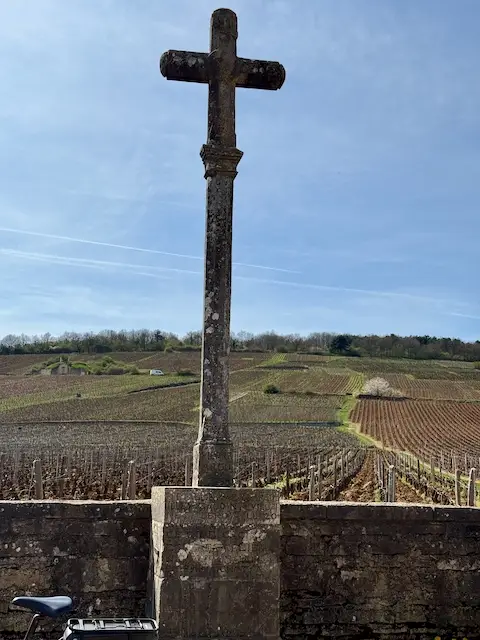
Katy and I made the relaxing 15-mile drive to Monkey Hollow Winery along southern Indiana’s state highways. For perspective, it’s just a bit longer than cruising from Beaune through Pommard, Volnay, and Meursault to Armand Heitz in Burgundy — a route that is wall-to-wall vineyards. Our drive? Farmland, streams, and trees as far as the eye could see, and not a vine in sight until we rolled up on Monkey Hollow. (See Hurdle One. The math still isn’t doing us any favors.)
But what Monkey Hollow lacks in postcard vineyard vistas, it more than makes up for in warmth, quality, and a bartender who seems to have a built-in CRM where most of us keep our brain fog.
Free tastings — about five pours. We had a fantastic time with our bartender, Kim, who clearly remembers every human who walks through those doors. When she asked if anyone was joining us, we shared my Friday the 13th saga and mentioned our friends had been there the day before. Without missing a beat, Kim said, “That must have been Bryan and Cathy — and they were talking with a couple from KC.” At that point, I was convinced she could probably run the entire guest history of the place off the top of her head, vintage by vintage.
Our friends admitted they’d been to Monkey Hollow a few years ago and weren’t impressed. This time? Much better. And we quickly agreed. Once again, we were pleasantly surprised by the quality in the glass. After another round, some cheese and crackers, a few more bottles to bring back to friends in Fishers, and probably more laughter than any two people deserve on a Saturday afternoon, we pointed the car back toward Ferdinand, feeling pretty good about where Indiana wine is headed.
Ferdinand: Beer, Wings, and People From Everywhere


We checked into the hotel, explored the grounds of St. Benedict’s, and landed at their Brew Works for beers and dinner. The recommendation from our friends was spot-on. Great beers, incredible wings, and a pizza that had no business being that good at a monastery brewery. (Though, come to think of it, monks have been perfecting beer and food for centuries — so maybe it makes perfect sense.)
The best part? Sitting near the bar, we overheard conversations from people who’d traveled from all over the country. Ferdinand, Indiana — a small town that most people couldn’t find on a map — was buzzing with visitors on a Saturday night. That’s not a fluke. That’s a scene.
The Takeaway: Indiana Is Pouring Forward
This weekend was a microcosm of everything that’s right about the Indiana wine scene right now. Yes, the math is still daunting. Yes, Father Time hasn’t been particularly generous. And yes, the perception problem is real. But consider what we experienced in just a few hours:
- Wineries producing wines that genuinely surprise people — in a good way, not the “oh, you made this in your garage?” way.
- Out-of-state and out-of-town visitors (KC, Evansville, Indy) intentionally seeking Indiana tasting rooms.
- Returning visitors are noticing real improvement — our friends went from unimpressed to enthusiastic in just a few years.
- A sense of community and hospitality that you simply don’t get at a crowded Napa tasting bar where they charge you $50 and rush you out the door.
Indiana’s wine scene doesn’t need to be California, France, or Greece. It needs to be Indiana — gritty, creative, community-driven, and getting better with every vintage. The vines are deepening their roots. The winemakers are honing their craft. And the stories? The stories are already flowing.
Indiana may have 60.7 square miles between every vineyard hectare, but when you finally arrive? The pour is worth the drive.
Leave a Reply