
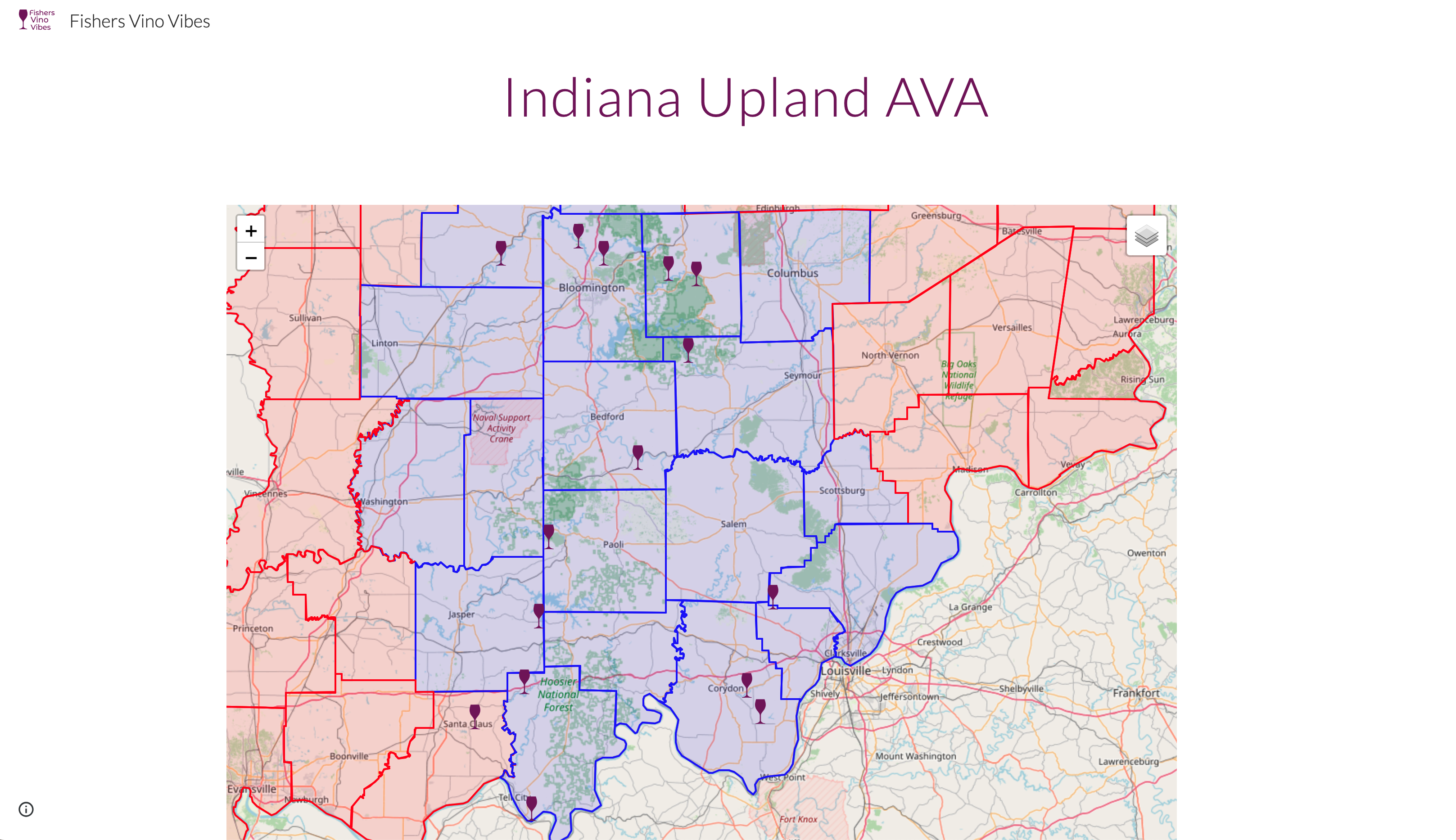

Since retiring, I have developed a passion for writing. While blogging about various enjoyable experiences, I plan to focus on exploring the Fisher’s wine scene, particularly at restaurants and wine stores, to discover different types of wine selections and the best values. Additionally, I will continue my Indiana journey to visit all 100+ wineries in Indiana, starting with a focus on the Indiana Uplands AVA (see pic from above). Nevertheless, considering my scatterbrained tendencies, I might end up heading in unexpected directions. So, what is the Indiana Upland AVA?
An American Viticultural Area (AVA) is a designated region in the United States where growers cultivate wine grapes. Each AVA has distinct geographic, climatic, soil, and topographic characteristics that distinguish it from surrounding areas. These unique features influence the types of wines produced in that region.
To qualify as an AVA, a region must possess geographic elements that affect grape-growing conditions. Additionally, natural features such as rivers or mountains typically define its boundaries, and the local community, consumers, and industry professionals commonly use and recognize its name. This designation allows winemakers to showcase the origin of their wines, helping consumers identify and select products from specific regions.
For a wine to display an AVA designation on its label, at least 85% of the grapes used in its production must come from that AVA. Furthermore, the producer must fully finish the wine within the state where the AVA is located.
What are AVAs
American Viticultural Areas (AVAs) are defined and regulated by the Alcohol and Tobacco Tax and Trade Bureau (TTB), part of the U.S. Department of the Treasury. Like European designations such as France’s AOC and Italy’s DOC, AVAs identify a wine’s geographic origin, but AOC and DOC rules are far stricter, controlling grape varieties, yields, and winemaking methods to ensure consistent quality and typicity. The AVA system is more flexible, focusing mainly on origin with relatively few requirements for viticulture and winemaking.
As of 2024, there are 273 AVAs across 34 states, with more than half (152) in California. Their sizes vary dramatically. The Upper Mississippi River Valley AVA spans more than 29 million acres across Minnesota, Wisconsin, Iowa, and Illinois, while the Ohio River Valley AVA covers over 16 million acres in parts of Indiana, Kentucky, Ohio, and West Virginia. Oregon’s Willamette Valley AVA encompasses more than 3 million acres, about the same size as the Indiana Uplands AVA.
By comparison, Napa Valley covers 225,000 acres, Red Mountain AVA just 4,040 acres—making it the smallest appellation in Washington State—and Cole Ranch AVA in Mendocino County, California, only 60 acres.
Indiana Uplands AVA
The Indiana Uplands AVA, established on February 4, 2013, is a region of unique and diverse characteristics. It covers 3,072,000 acres across Bartholomew, Brown, Clark, Crawford, Daviess, Dubois, Floyd, Greene, Harrison, Jackson, Lawrence, Martin, Monroe, Morgan, Orange, Owen, Perry, Scott, and Washington counties. Reading the Tax and Trade Bureau description is like reading a novel from the 1800’s.
“(1) The beginning point is on the Tell City map at the confluence of the Anderson River and the Ohio River near Troy in Perry County. From the beginning point, proceed north-northwesterly in a straight line, crossing to the Jasper map, to the intersection of State Roads 62 and 162, approximately 3.5 miles north of Santa Claus; then” … “
This region has a rich viticultural history dates back to the 1840s when early settlers planted vineyards near Starlight. Many of these settlers were German immigrants with a wealth of viticultural knowledge and practices.
Topgraphy
The Indiana Uplands AVA, with its unique topography and soil composition, creates distinct mesoclimates that influence the flavor of its wines. The region’s underlying bedrock, consisting of alternating layers of limestone, shale, and sandstone, influences the low-fertility soil, which is made up of finely powdered red-yellow silt or clay of wind-blown origin. The rolling hills and limestone-rich soil provide excellent drainage and mineral content ideal for viticulture. This results in lower crop yields but more concentrated and flavorful wines. The Uplands, about 300 feet higher in elevation than surrounding areas, are cooler during the summer, allowing for an average growing season of 170 days while providing some protection from frost in spring and fall. This slower ripening process helps the grapes develop good acidity, color, tannins, and fruit flavors.
The Indiana Uplands AVA is in the Winkler Region III. The Winkler Region III is part of a classification system called the Winkler Scale or Index. It categorizes wine-growing regions based on climatic conditions, specifically heat summation during the growing season. This system helps viticulturists and winemakers determine which grape varieties are best suited to a given area and compare global wine regions. Central Valley, CA, southern parts of Napa Valley, and areas in Tuscany, Italy, also are in the Winkler Region III classification.
Today, the Indiana Uplands AVA is home to many wineries. Some industry experts believe that Midwest wines, including those from the Indiana Upland region, are improving to the point where they may challenge some of the best wines from more established regions. The Indiana Uplands AVA is gaining recognition for producing quality wines that reflect its unique terroir, and I am excited to be a part of this journey of improvement and recognition, which holds a promising future.

Leave a Reply